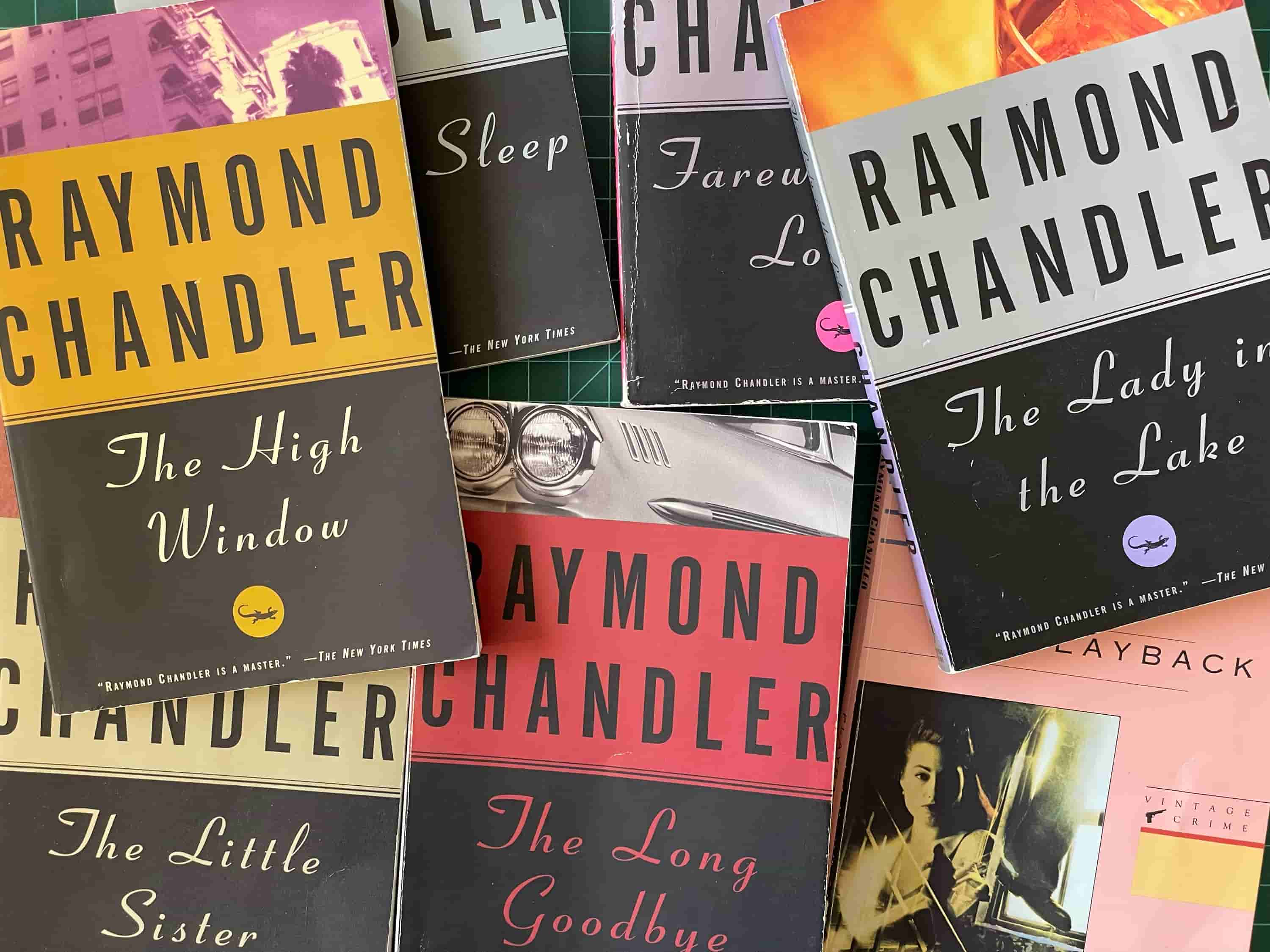
The Novels of Raymond Chandler
as fortune would have it, i happened upon a pile of pristine, unread copies of The Big Sleep, The High Window, The Lady In The Lake, and The Long Goodbye in a used bookstore last spring. having read one or two of Chandler’s books many years ago but not remembering much about them or which ones i’d read, i bought them all.
fifty cents a piece. a steal!
if you’re not familiar with the work of Raymond Chandler, he’s primarily known for writing sentences. that may sound a bit obvious, him being a writer and all. and yet, of all the writers who write sentences (and so many of them do!), his tend to be particularly well regarded.
the idea of a Chandler sentence is to take a word like “marmalade” and use it to describe something unexpected like, “he shifted in his chair with the unease of someone who just realized his pants were filled with marmalade.”
i’m not half the wordsmith Chandler is of course, but you get the idea.
since i was absolutely sure i’d never read it, i decided to start with The High Window. it’s a great book, as Ramond Chandler books go. and i can say that with some authority because after i finished The High Window, i decided to read the rest of Chandler’s novels (all six of them) in publication order. i’d go so far as to say that The High Window is the best of the bunch.
to get it out of the way, there are some not-so-great things about these books: Chandler writes female characters atrociously. furthermore, his descriptions of flirtation and romance could easily be confused for sexual assault. and he’s not much better when it comes to race, though it all has the feeling of “the author was a product of a time and place” rather than anything overt. but it’s still not great. and considering how much effort he put into these books, it feels kind of lazy. like, how could a man who could write so eloquently about marmalade lean so heavily on such boring stereotypes and uninspired character tropes?
Chandler’s novels star Phillip Marlowe, a private investigator. he’s tall, good-looking, smart, and, above all, virtuous. he can’t be bought, seduced, or threatened, and would rather take a beating than betray a client. he’s also not one to turn down a drink. or ten.
what makes The High Window particularly good is that in addition to all those brilliant sentences, the mystery is particularly well constructed. Marlowe is described as an avid chess player and in this particular investigation it actually feels like he thinks like a chess player, always one or two steps ahead of his various opponents (the police, the mob, his own client, the estranged wife, et al.) and the reader themselves. but Chandler is so great at describing people and places, very specific mannerisms as well as architectural details, furniture, and items of clothing, that the reader has this sense that they could possibly unravel the mystery themselves, if only they could think as cleverly as Marlowe. of course if the reader fails, the dots are connected at the end of the book. but if the reader succeeds, they get to feel like they’ve done a bit of detective work. it’s quite fun.
the other six books do this with varying degrees of success. to be fair, it’s got to be a very difficult trick to pull off, figuring out how to tell the reader what they absolutely need to know to figure out a case without making it so obvious that it spoils the ending. and to do it with such panache. that’s not to say that Chandler isn’t guilty of a few wildly implausible plot twists here and there, but i did get to feel a bit like a detective as i read through these. and it mostly felt like honest work.
sitting on my shelf for some future reading binge: the novels of Dashiell Hammett.